

Published July 8, 2026
First Friday Update For July 3, 2026 (but on a tuesday)


Holidays and such. Real estate. The market. Let's Taco Tuesday about it.
We have 2,615 existing single-family homes on the market in El Paso County today. That's plenty.
Inventory was 2,345 a month ago, so we're up 11.5% month over month. Buyers have more choices than they've had in years.
One thing that really caught my attention: June's median list price was $499,900... and the median sold price was also $499,900.
At first glance, you'd think the market is firing on all cylinders.
But sold homes only tell the story of the winners. The homes that don't sell never make it into those sold-price statistics.
It's like Nelly said back in the day "2 is not a winner and 3 nobody remembers. ey ey, ey, ey ey ey"
So let's look at the rest of the market.
Year-to-date cancelled and expired listings
- 2026: 2,809
- 2025: 2,337
- 2024: 1,785
- 2023: 1,510
- 2022: 810
- 2021: 652
That's the highest number of failed listings we've seen since 2014. Coincidentally, today's inventory levels are also similar to 2014.
Go back even further and you'll find that between January 1 and July 7, 2010, there were 3,946 cancelled and expired listings.
The difference is the reason.
In 2010, buyers were worried the housing market hadn't found a bottom. The economy was weak, unemployment was high, and confidence was low.
Today is almost the opposite.
- June 2010 unemployment: 9.5%
- June 2026 unemployment: less than half that.
Whether you love or hate the BLS numbers, they're the best national benchmark we have.
Nerd alert examples
In June 2010:
- Median sold price in the Colorado Springs MSA: $205,000
- Average 30-year mortgage rate: 4.75%
- Median household income: about $51,227
Using reasonable assumptions for taxes and insurance, that works out to roughly $1,319 per month for a median-priced house with 100% financing.
That's about 31% of the median household income going toward housing—a level that's historically considered manageable.
Now compare that with today.
June 2026:
- Median sold price: about $500,000
- 30-year mortgage rate: around 6.5%
- Estimated median household income: about $87,000
Again using reasonable assumptions for taxes and insurance—and yes, before my lender friends jump in, I'm intentionally keeping this an apples-to-apples comparison with no buydowns or mortgage insurance—the payment comes to roughly $3,577 per month.
That's about 49% of the median household income devoted to the mortgage payment alone.
That. Is. Not. Sustainable.
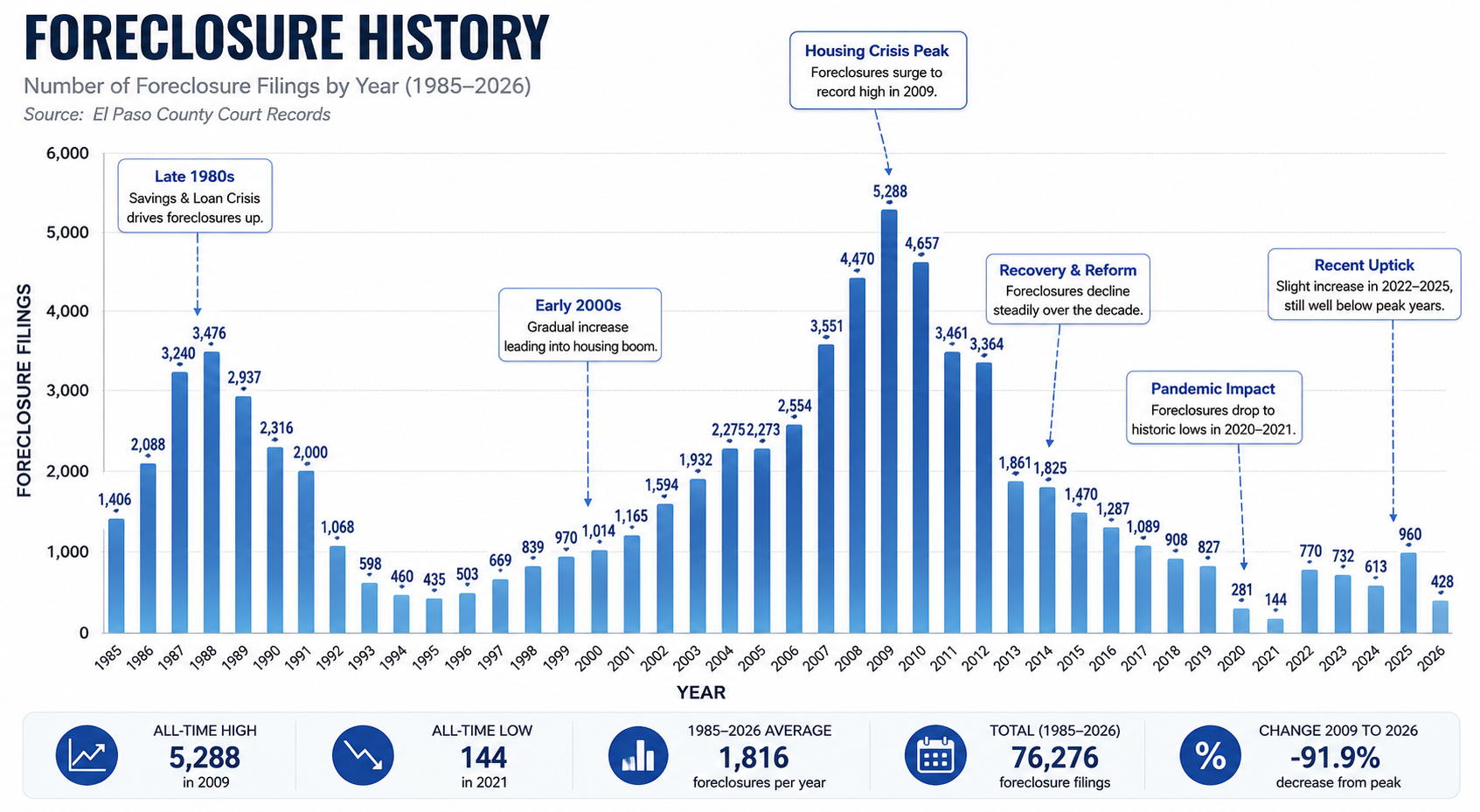
Yet people are holding on remarkably well. You would think by now foreclosures would be all over the news and all over your neighborhoods but they're just not! This is the data from the El Paso County Trustee for total foreclosures by year since the year that I was born. As you can see we are nowhere near historic levels despite the fact that the median household is getting squeezed hard.
How hard are households getting squeezed exactly? I'm proud to say I got ChatGPT to crash crunching data and got it to a point where it was defensive and apologetic. I really thought for a moment there that it may start crying. #empathy #calmdownAI
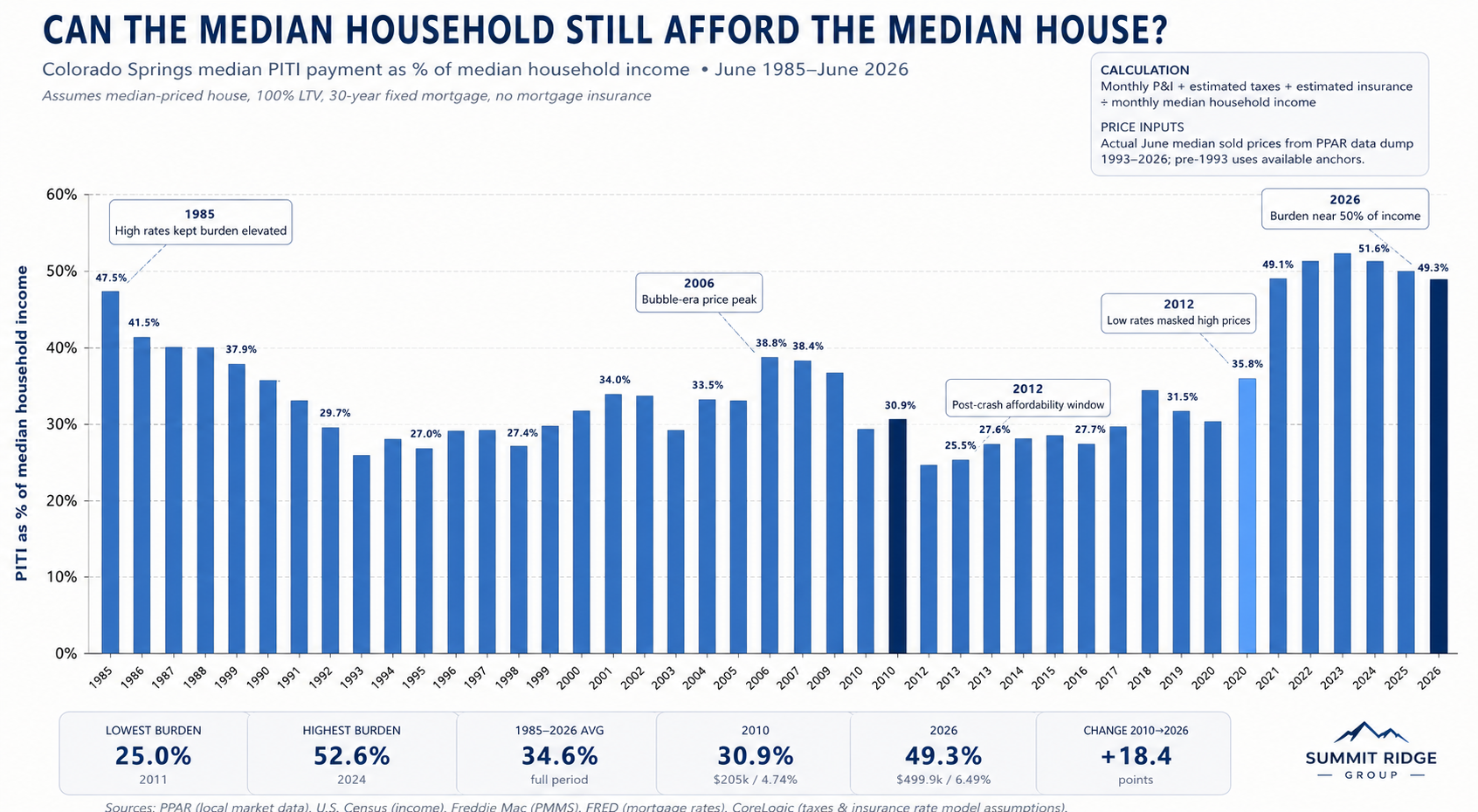 I spent quite a bit of time building this data, and I double-checked the calculations. The takeaway is pretty straightforward: we're watching one of the largest affordability squeezes on homeowners in modern history.
Keep in mind, this chart only measures PITI (principal, interest, taxes, and insurance). It does not include maintenance, repairs, renovations, HOA dues, utilities, or any of the other costs of owning a house. At the same time, Americans are also dealing with record or near-record expenses for many other parts of daily life—utilities, vehicle payments, insurance, childcare, groceries, and more.
So how does that show up in today's Colorado Springs market?
From talking with a lot of agents—both within Summit Ridge Group and at other brokerages—the common theme is that deals have become much harder to put together. Buyers feel stretched, sellers feel anchored to yesterday's prices, and very few people walk away from a transaction feeling like they got a great deal.
Sellers are realizing the days of listing a neglected house and expecting multiple offers over asking are largely behind us. Buyers, meanwhile, are facing the reality that a median-priced house can consume nearly half of a median household's gross income before paying for a single repair, utility bill, or home improvement.
When you combine today's prices with today's interest rates, several things start to make sense:
- Renting is often less expensive than buying on a monthly basis. For much of the 2012–2021 period, the opposite was often true. Low mortgage rates made the decision to buy relatively easy for many households. Today, renting can be the lower-cost option while someone saves for a larger down payment or waits for conditions to improve.
- Investment real estate has become much more challenging. At current prices and financing costs, many leveraged purchases require significant down payments just to approach break-even cash flow. When stocks are near all-time highs and leveraged real estate often produces little or no immediate cash flow, some investors choose to allocate capital elsewhere. Others have shifted toward developing build-to-rent communities rather than competing for existing inventory.
- Investor demand has cooled. Institutional buyers, short-term rental operators, and speculative investors are not providing the same level of demand they did just a few years ago. They're still active in certain segments, but they're no longer absorbing inventory the way they once did.
- Higher inventory feeds on itself. As more houses sit on the market longer, buyers become more patient and selective. That forces additional price reductions, which encourages even more buyers to wait. It's a feedback loop that can keep the market softer until affordability improves or inventory declines.
None of this means the Colorado Springs market is "crashing." Employment remains relatively healthy, homeowners generally have strong equity positions, and distressed sales remain low by historical standards. But it does suggest we're in a market where affordability—not fear—is the primary headwind, and that's a very different dynamic than what we experienced in 2008–2010.
Without getting too deep into personal anecdotes, I can tell you this market feels unusually fragmented. I've sold houses in less than a week, we've had multiple-offer situations at Summit Ridge Group within the last month, and at the same time I've watched other houses sit on the market for months with very little activity.
The common thread is value. Buyers have become much more selective and are no longer willing to overlook the small issues they ignored a few years ago. Houses that exceed expectations for their price point are still selling quickly. Houses that simply meet expectations—or fall short—are often sitting, reducing their price, and waiting.
That's what makes today's market so challenging to analyze. It's easy to find examples that support almost any opinion. One neighborhood or price range can feel red hot while another feels completely stagnant. The market isn't moving as one; it's becoming increasingly segmented, and pricing, condition, location, and presentation matter more today than they have in years.
At the end of the day it's like this. Buy what you need when you can afford it. Hold it as long as is reasonable. Real estate is for the long haul amigos. Enjoy some tacos for me on this fine Tuesday if you've made it to here in my Friday update.